

Port Volunteers
By Tim Schermetzler of CSD Attorneys at Law P.S.
Last month at the WPPA Small Ports conference in Chelan, I presented alongside Travis Merrill from the Port of Allyn and Commissioner Amanda McGylynn from the Port of Brownsville on volunteers at port districts. Small and large ports alike utilize volunteers in different capacities, ranging from a person volunteering a few hours to clean up a shoreline to long-term volunteers serving on advisory committees. Following the presentation, I received more questions about managing volunteers at ports. Given the level of interest, this month’s column will review some of the legal considerations for ports when working with volunteers.
A first step is to define what a volunteer is. That may appear obvious, but from a legal perspective, the definition of volunteer flows from the laws applicable to the issue involving the volunteer. In most cases, legal considerations for volunteers deal with employment law and injuries. The Washington Department of Labor and Industry (“L&I”) defines a volunteer as a person who “freely gives their time and talents without expectation of pay. A volunteer can only work for an educational, charitable, religious, state or local government, or non-profit organization.“[1] In this legal context, L&I defines volunteer for the purpose of application of worker or employee protections and benefits, including under the Industrial Insurance Act – Title 51 RCW (commonly referred to as “Workers’ Compensation”).
Workers’ Compensation is a no-fault insurance program administered by L&I to provide wage loss and medical benefits to workers hurt on the job. Generally, volunteers are not covered by Workers’ Compensation. However, the state permits injured volunteers to receive the medical aid benefits of Workers’ Compensation if certain conditions are met. These conditions are:
- The person meets the definition of a volunteer in RCW 51.12.035(2), specifically that they perform assigned or authorized duties for the port by that person’s free choice, receive no wages, and are registered and accepted as a volunteer by the port;
- The port gives notice of its intent to cover all of its volunteers to the Director of L&I and
- The port pays all premiums and assessments due in order to cover the volunteers.
While one of the requirements to maintain status as a volunteer is to receive no wages, volunteers can still receive reimbursement of expenses (e.g., mileage, parking, etc.), nominal stipends or perks (e.g., food or lodging), gifts of appreciation, or unpaid job training or academic credit.
One of the key considerations when working with volunteers is what the volunteer is working on. From a legal perspective, this is often referred to as the scope of work. The Port should consider and define the scope of volunteer work before engaging with the volunteer. While not required, a volunteer job description or similar written outline of the tasks can be a useful tool. Within the volunteer job description and defined scope of volunteer work, the port should consider the need for safety training or safety equipment necessary for the volunteers to perform the work, whether the volunteer is performing work that might be viewed as displacing work of employees or could implicate union labor subject to a collective bargaining agreement (“CBA”), and whether the volunteer work requires any certifications or specialized training. Also note that if a volunteer at the port is also a port employee, under the Fair Labor Standards Act (FLSA), a public sector employee cannot volunteer uncompensated time to perform the exact same work that they are already employed to do by that same government agency.
In addition to volunteer job descriptions, another tool for managing volunteers is for the Commission to adopt a volunteer policy. A port is not legally required to adopt a volunteer policy; however, this can be a management tool to help staff direct volunteer work, keep the volunteer work within the parameters directed by the Commission, keep it focused on the goals or purposes set forth in the policy, and authorize or delegate to staff the authority to manage volunteers. A policy can authorize activities for volunteers, define volunteer expectations, require that volunteers follow the volunteer policy along with all other port policies, notify volunteers whether the port elected to cover volunteers under Workers Compensation, set forth the status of the volunteer, and address publicity and photographic/video rights and rules.
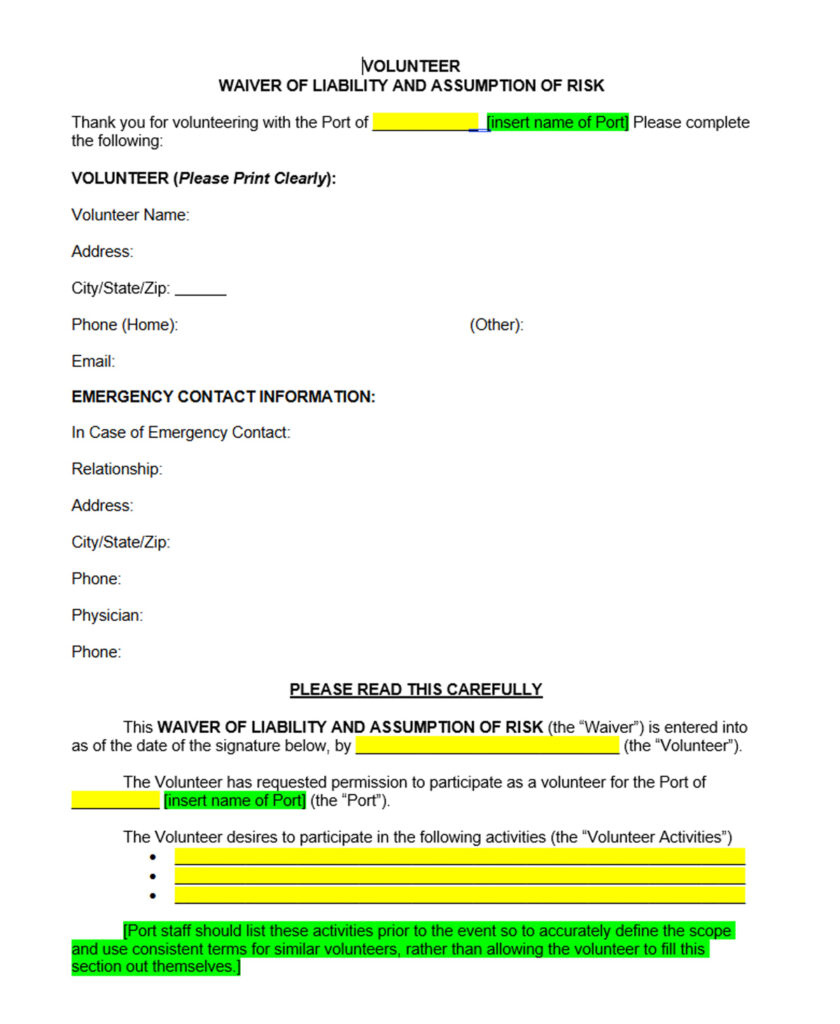 Any port that uses volunteers should require each volunteer to complete a volunteer form. At a minimum, the form should include the scope of work for the volunteer, an acknowledgement that the person is performing these tasks of their own free choice and with no wages, and that they assume the risk and release the port from liability if that volunteer injures themselves.
Speaking of liability, your port should discuss with your insurance provider whether and to what extent the port’s insurance policies cover volunteers. Whether your insurance will cover a volunteer in the same manner as an employee for liability purposes will depend on your port insurer and the policy itself.
In addition to volunteer forms, ports that regularly engage with volunteers also may want to consider incident report forms, donation forms for when volunteers donate supplies or items in addition to the donation of their labor, and a volunteer disengagement letter if your port needs to separate from a volunteer. When a port engages with a volunteer group, each individual volunteer should still fill out the port’s volunteer forms, but the port may also consider other forms such as access or license agreements for groups working on port properties (e.g., local business volunteers to repair a damaged structure at a port-owned and maintained park).
Lastly, ports should be cognizant of Open Public Meeting Act (“OPMA”) and Public Record Act (“PRA”) implications when working with volunteers. If a volunteer advisory board or committee is acting on behalf of the port commission – the governing body – then the OPMA applies. If the volunteer board performs purely advisory functions and has no authority beyond providing advice to the Commission at an open public meeting, then the OPMA would not apply. However, even if the OPMA doesn’t apply, ports should consider the optics of not allowing the public to attend – even if not required, should an advisory committee meeting be open to the public? Should notes be taken? The answers to these questions will be specific to the port and the project that the advisory committee discusses. Under the PRA, volunteer records, such as waivers, rosters, etc., may include information that is exempt from disclosure per RCW 42.56.250(1)(d) – residential addresses, telephone numbers, personal email addresses, Social Security numbers, driver’s license numbers/identification card numbers, and emergency contact information.
Volunteers can make significant and valuable contributions to the operations at your port. However, it is important for ports to prepare to use volunteers effectively and take the necessary steps to protect your port from any potential liability or other exposure that could arise from the volunteer service.
And to all of the volunteers helping Washington ports – thank you!
As always, if you have specific legal questions, work with your port’s legal counsel. If you have a general question or topic of interest for Knowing the Waters, please e-mail me at tschermetzler@csdlaw.com.
[1] https://lni.wa.gov/insurance/insurance-requirements/volunteers